Pages

Monday, 13 May 2019

Crystals

Aim: To learn about a saturated solution and how to make crystals
Definition of solution
A liquid mixture, when something is dissolved into a liquid (eg: sugar in water) 

Definition of saturated
Having or holding as much as can be absorbed of something (when no more sugar or borax can be dissolved into the water)


In groups of three you will make three different types of crystals and compare the results.


Image result for borax crystals

Ratio; 3 Tablespoons Borax per 1/2 cup water

Materials

1) Pipe Cleaners
2) Peg
3) Borax
4) Stirring Stick
5) Warm Water   

Process

Step 1:Shape pipe cleaners into stars 
Step 2: Hang star o
Step 3: Label your cup
Step 4: Make up salt solution
Step 5: Tie some string onto your stirring stick
Step 6: Make sure the string is in the Saturated solution

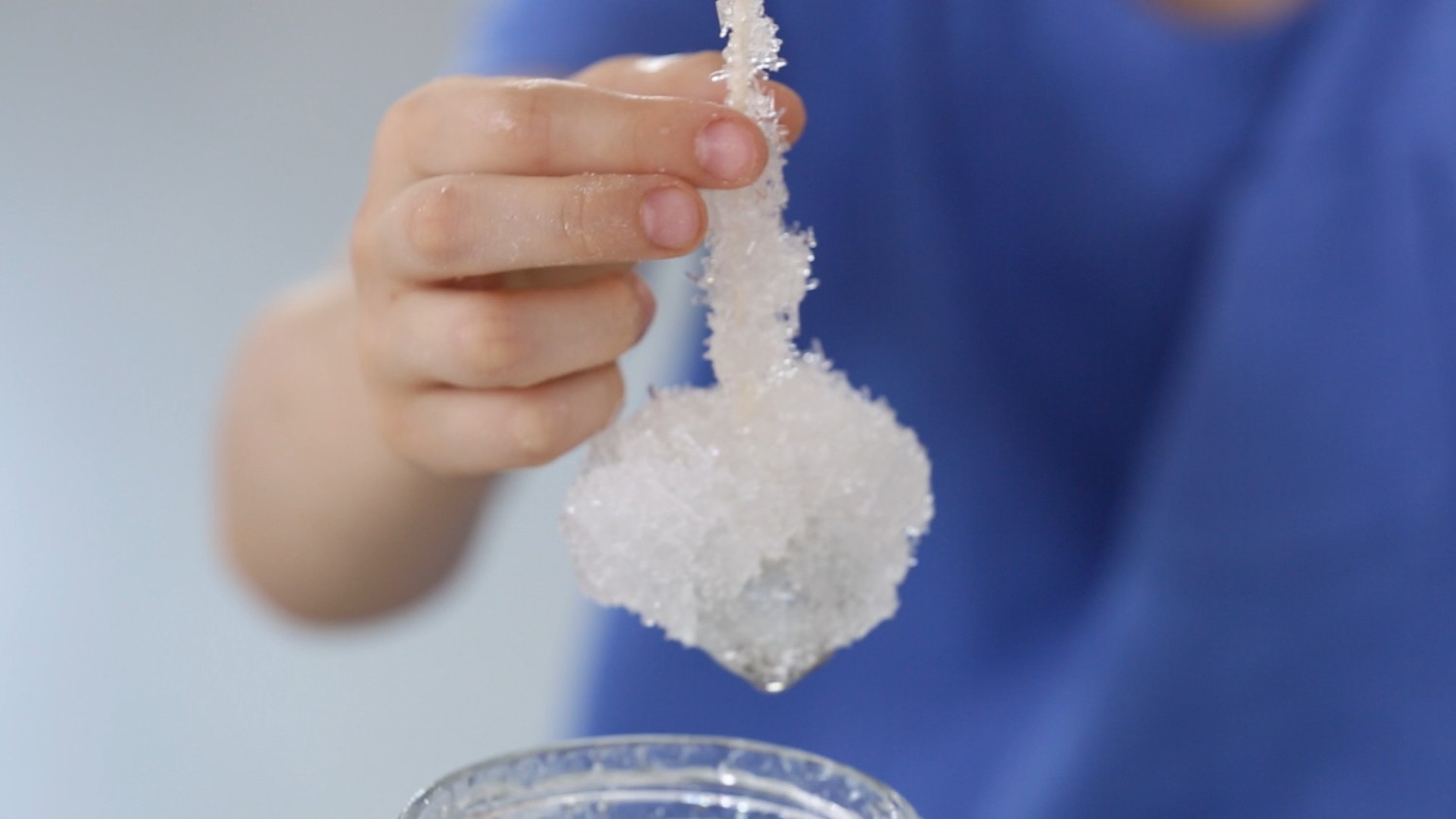
Sugar Crystals

Grow your own Sugar Crystals

Ratio: 1 cup sugar to 1/2 cup water

Materials

1) String
2) Sugar
3) Cup
4) Stirring Stick
5) Warm Water

Process

Step 1: Make your Saturateded mixture
Step 2: Mix it for about 5-10 mins
Step 3: Tie a piece of string onto your stirring stick
Step 4: Place it into your mixture and 
Step 5: Wait for maybe a week


Image result for how to make salt crystals

Ratio: 4 Tablespoons salt to 1/2 cup water

Materials

1) Pipe Cleaners
2) String
3) Pegs
4) Cups
5) Salt

Process

Step 1: Make your Saturateded mixture
Step 2: Mix it for about 5-10 mins
Step 3: Tie a piece of string onto your stirring stick


Step 4: Place it into your mixture and 
Step 5: Wait for maybe a week

Findings

Describe your crystals in the table below.

Extra Findings while mixing...

I found that when mixing it takes a little while to make the mixture but also when you leave it for a few secounds, and you scrape your stick along the bottom and bring your stick up it still has borax on it but then disolves again.
Crystal Type
Shape
(Describe the shape)
Size
(of individual crystals)
Hardness
(Crumbly to Rock Hard)
Borax
Image result for borax crystal cubic


Round squared ball


Big and Small
Hard
Sugar


Square

MediumSmooth
Salt

Image result for salt cubic crystal

Cube


What crystals worked out best and why?: 

Conclusion: 


Type
Explanation
Salt
Salt is formed by an evaportation by salty water, like sea water. Enclosed bays are where you could find sea salt. In region places.
Sugar
Most green plants produce sugars, they create a form of sugar. If a plant makes more food than it requires, it stores it. The sugar is made from many green plants.
Snowflakes
A snowflake creates an ice crystal. Water Vapour freezes normal crystals, building new ones - A snowflake also has 6 arms, sometimes


Type
Number of sides

Picture

2 EXAMPLES

Monoclinic
3

Image result for monoclinic orthoclase

Cube, Octahedron
Isometric
0Image result for isometric salt, pyrite, garnet,galena,fluorite,copper,silver,goldCube, octahedron
Hexagonal
7Image result for Hexagonal, quartzDipyramid, Primsm, rhombohedron
Teragonal
0Image result for Tetragonal chalcopyriteZircon, rutile
Orthorhombic
2Image result for orthorhombic topazSulfur, topaz
Triclinic


Image result for Triclinic AlbiteAlbite, rhodonite


Friday, 10 May 2019

Drama - Fitness and Body

How does Fitness affect my body and mind?

It affects my body by knowing that I have done fitness by puffing after.It increase my heart rate. If you do fitness regularly your micules get stronger. You use more energy which means you also need to eat more and also it makes you sleep better. Fitness releases stress your mind, improves coordination.

What fitness am I doing at the moment?

I am currently doing...

Netball- Thursday practices, Friday winter sport, Saturday game
Walking, running, scootering, biking, and walking
I get to school in 12 mins from my house

What is my fitness goal?

My goal is to practice on Fridays for netball on Saturday.

How is my goal going?

It's going really well as I do it for winter sport!

Monday, 6 May 2019

Rocket Science.

Today we are learning about filtering dirty water. We are learning about filtering. Here are some ideas of filtering....

  1. There's pool filtering
  2. Filtering removes bad stuff
  3. There's also cleaning filters and...
  4. Internet Filters
Your probably wondering Internet filters?... There's no such thing well actually there is.... Do you know the Snapchat app? Well that has filters.

Materials

  1. Filter Paper
  2. Bottle
  3. Scissors
  4. Funnel
  5. Sand
  6. Stones small
  7. Dirty water
Steps

  1.  Get a bottle
  2.  Cut it about the big line
  3. Get a filter paper round
  4. Make it into a cone
  5. Add sand into it
  6. Add pebbles on top of the sand
  7. Pour dirty water on top
  8. Count how many try trips per minute
Conclusion
The water that flowed through the filter was clear with a green tinge. The water flowed at 32 drops per minute. The bark,soil and leaves sat on top of the Peebles.
This experiment should turn out to be filtering water, which means the dirty water becomes clean water. This experiment is really easy to make, but I sujest you DON'T drink the water!!!! 
This experiment you can learn a lot about filtering as well. Here are some more ideas of what type of filters there are...

Water
Air
Oil
Kettle and 
Pool


It's your turn to try. Have a go!!

Thursday, 2 May 2019

Paper Plane

As I have written it on paper here is the working and my better part of my conclusion is in the working. Read carefully


Ballon Bottle


Image result for baking soda balloonsAim: To see which chemical 
mix creates the most gas.

Hypothesis: I think that when we add the baking soda and vinegar it will make the balloon inflate up.

Materials:
  1.  Bottle and ballons
  2.  Soda
  3.  Salt
  4.  Baking soda
  5.  Vinegar
  6.  Lemonade
Steps:
  1.  Get 2 bottles
  2.  Get 2 ballons
  3.  You need to pour halve a cup of vinegar in 1 bottle and the other half a cup of lemonade 
  4.  Add 3 teaspoons of baking soda in 1
  5.  and the other 3 scoops of salt and it may suck in 
  6.  Watch what happens
My images:


Findings:
That the 1 with salt does not inflate


Balloon 1
( 3 tsp baking soda, ½ cup vinegar)
Balloon 2
( 3 tsp salt, ½ cup soda)

Balloon Size (cm)
14 cm0cm
Bubbles
(small, medium, large)
SmallNone


Conclusion:

White Powders

Aim To learn about the makeup of different white powers.

There are a number of different white powders in our everyday life. Some of these are harmful and others not. Test the four white powders listed to see which one has been found at the airport.

Here are some examples of everyday kitchen white powders.
Flour, Cornflower, sugar, salt, baking soda, icing sugar, Tartaric acid, citric acid, gluten free flower

You will be given a small amount of 4 white powders on your car lard using a magnifying glass look at the powders.
Look at them under your magnifying glass and record what you see

These are the four powders we will be using. Upload a photo of each powder


  1. Cornflower
  2. Baking soda
  3. Salt 
  4. Sugar
Before you add the iodine, vinegar or water you will need to divide each powder into 3.

Materials
  1.  Iodine
  2.  Water
  3.  Baking sda
  4.  Sugar
  5.  Salt
  6. Cornflour
  7. Pipette
  8. Paper

Steps

  1.  Fold cardboard into 4s
  2.  Write, sugar, cornflower, salt and baking soda in each square
  3.  Divide each into 3s
  4.  Add Iodine to each 1
  5. Add water to each 1
  6. Add vinegar to each 1
  7. And watch
Findings

Appearances.                Sugar.            Salt.              Baking Soda.         Cornflower 
Texture.                        Crystals.        Small            Tiny.                      Chunky
Smell.                           Nothing.       Nothing.        Nothing.                Nothing
Iodine.                          Colour.          Dissolves.      Hardens                Slides-harden
Water                            Melts.          Shiner            Nothing                  Slides-harden
Vinegar.                        Dissolves.     Shines.          Bubbles.                Slides-harden


Finding...

Whilst I was doing this experiment with my group we found a lot of things. We found out what the mystery powder was. Can you guess? IT WAS BAKING SODA. It was really easy finding out which was which as we did the vinegar and it made bubbles like the other one. We learnt a lot from this experiment as we never knew things but there was a lot of experimenting. How did your experiment go?